Skip to content
Facebook-f Twitter Instagram Youtube

Updating Large Format Printer & CNC Machine News Blog

  • Machines
    • 3D Printing
    • CNC Plasma Cutting
    • CNC Router
    • CO2 Laser Cutting
    • Direct to Film (DTF) Printing
    • Fiber Laser Cleaning System
    • Fiber Laser Cutting
    • Fiber Laser Engraving
    • Film Cutting
    • Flatbed Cutting Machine
    • Flatbed Printer
    • Heat Press
    • Laminator
    • Large Format Printer
    • Laser Marking
    • Power Equipment
    • Screen Printing
    • Vinyl Cutting
    • Welding
  • Consumables
    • ECO-Solvent Inks
    • Label Paper
    • Spindles
    • Sublimation
    • Toolings
    • UV Inks
  • Software & Resources
  • News and Updates
    • Events & Expo
    • Stock Updates
    • New Machinery
    • Warehouse Updates
    • Media & Press
Search
Facebook Twitter Instagram Youtube

Updating Large Format Printer & CNC Machine News Blog

  • Machines
    • 3D Printing
    • CNC Plasma Cutting
    • CNC Router
    • CO2 Laser Cutting
    • Direct to Film (DTF) Printing
    • Fiber Laser Cleaning System
    • Fiber Laser Cutting
    • Fiber Laser Engraving
    • Film Cutting
    • Flatbed Cutting Machine
    • Flatbed Printer
    • Heat Press
    • Laminator
    • Large Format Printer
    • Laser Marking
    • Power Equipment
    • Screen Printing
    • Vinyl Cutting
    • Welding
  • Consumables
    • ECO-Solvent Inks
    • Label Paper
    • Spindles
    • Sublimation
    • Toolings
    • UV Inks
  • Software & Resources
  • News and Updates
    • Events & Expo
    • Stock Updates
    • New Machinery
    • Warehouse Updates
    • Media & Press
  • Machines
    • 3D Printing
    • CNC Plasma Cutting
    • CNC Router
    • CO2 Laser Cutting
    • Direct to Film (DTF) Printing
    • Fiber Laser Cleaning System
    • Fiber Laser Cutting
    • Fiber Laser Engraving
    • Film Cutting
    • Flatbed Cutting Machine
    • Flatbed Printer
    • Heat Press
    • Laminator
    • Large Format Printer
    • Laser Marking
    • Power Equipment
    • Screen Printing
    • Vinyl Cutting
    • Welding
  • Consumables
    • ECO-Solvent Inks
    • Label Paper
    • Spindles
    • Sublimation
    • Toolings
    • UV Inks
  • Software & Resources
  • News and Updates
    • Events & Expo
    • Stock Updates
    • New Machinery
    • Warehouse Updates
    • Media & Press
Search
ACM DiBond Cutting on EasyRoute CNC Router and Fold as Box with 90 Degrees V-Bit

ACM DiBond Cutting on EasyRoute CNC Router and Fold as Box with 90 Degrees V-Bit

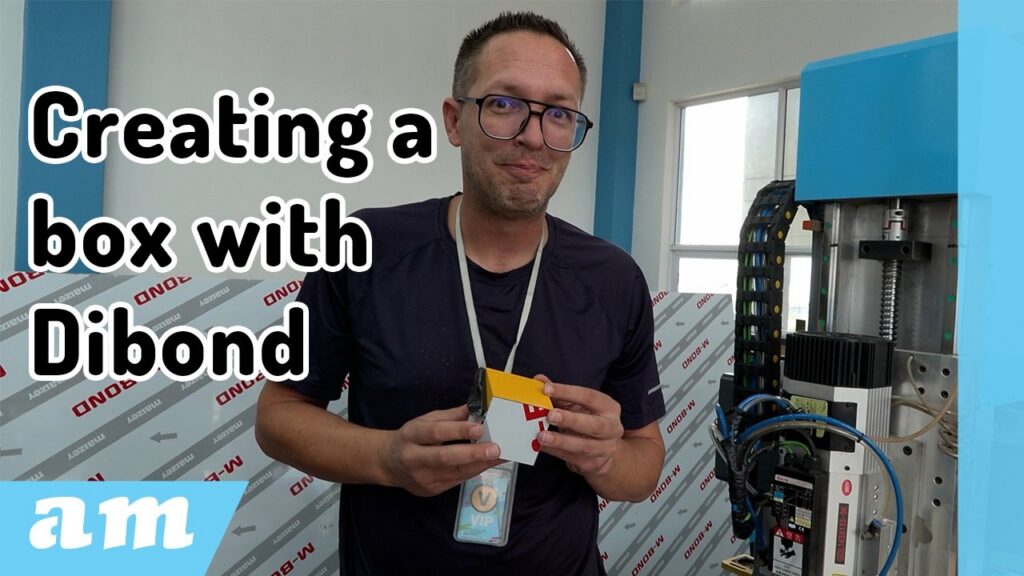
How to CNC Cut DiBond (Mbond) and Make a Simple Box

DiBond — or in this case, Mbond — is a versatile composite material made from a polyethylene core sandwiched between two thin aluminium sheets. It’s widely used in signage thanks to its durability, lightweight structure, and availability in a range of bold, eye-catching colours. If you’re working with CNC machines or planning to enter the signage industry, this is one material you’ll be using regularly.

However, despite its popularity, DiBond isn’t always the easiest material to cut cleanly. That’s exactly what this guide is about — showing you how to machine it effectively using a CNC router, even with basic tooling.


Understanding the Material

The layered construction of DiBond is what makes it both useful and tricky. The aluminium outer layers provide strength and a clean finish, while the polyethylene core allows for some flexibility — especially when folding.

But that aluminium skin also means you need to approach cutting with the right technique. If not done properly, you can struggle with rough edges, incomplete cuts, or poor folding results.


Keeping It Simple: Tooling

For this demonstration, the focus is on simplicity. Instead of using specialised tooling, a standard and inexpensive 90° router bit is used to prove that clean, accurate cuts are still achievable.

That said, it’s worth noting that for optimal results — especially in professional applications — a slightly different bit (typically around 91°) is often preferred. This subtle difference can significantly improve fold quality and final appearance. More on that in a follow-up discussion.


The Cutting Process

With the material secured and ready, the cutting begins using a straightforward CNC setup.

A few important considerations during machining:

  • Flatness is critical: Your machine bed must be perfectly flat. Any inconsistencies will affect cut depth and accuracy.
  • Cut depth matters: You may need to cut slightly deeper than expected to properly get through the aluminium layer.
  • Two-step cutting approach: The toolpath includes stepped cuts. These are intentional and help ensure the outer edges are fully cut while also preparing the material for folding.

This method keeps things simple while still delivering reliable results — especially useful for those who are still learning or don’t yet have access to specialised tools.


Forming the Box

Once the cutting is complete, the material can be folded along the machined lines to form a basic box shape.

Even with a simple setup, the result is surprisingly effective:

  • Clean edges
  • Defined fold lines
  • A solid, functional shape

However, you’ll notice that the seams — where the folds happen — aren’t perfectly tight. This is expected when using a standard bit. The fold quality can be improved significantly with the correct tooling and setup.


Final Thoughts

This project shows that you don’t need expensive or specialised tools to start working with DiBond. With a basic CNC router, a simple bit, and the right approach, you can produce clean, usable results.

That said, tooling does matter — especially when it comes to achieving professional-grade finishes. In a follow-up, we’ll explore how using the correct router bit can dramatically improve the cosmetic quality of your work.


If you’re looking to get into CNC cutting or signage production, DiBond is a great material to start with. Mastering the basics like this puts you on the right path to producing high-quality, professional results.

Stay tuned for the next step.

In a time where AI and smart technologies are transforming industries, AM.CO.ZA has emerged as a leader in CNC routers and printing machines. With more than 11 years of experience, they offer a diverse range of advanced products, including CNC Routers, Large Format Printers, Vinyl Cutters, Laser Cutters, Plasma Cutters, and DTF Printers. Their solutions serve a wide array of sectors, from manufacturing and engineering to the creative arts.

Machines, Consumables and Parts Available from https://buythis.co.za/

For more info on Advanced Machinery visit https://am.co.za/

Subscribe to AM.CO.ZA’s YouTube Channel: https://www.youtube.com/@AchievementMatters?sub_confirmation=1

Chat with us by sending “hi” on WhatsApp to 060 600 6000​.

PrevPrevious Update
Next UpdateNext
  • Enquiry: 060 600 6000
  • Support: 076 666 6655
  • Training: 060 818 1818
  • Jo’burg : 087 802 5368
  • Cape Town : 087 802 5368
Chat to us by sending “hi” on Whatsapp: 060 600 6000​
Envelope Youtube Facebook Pinterest Twitter Instagram

This website is developed by Advanced Machinery (Pty) Ltd. The domain name updating.co.za is the property of Bates Trust IT003077/2015(G), and its exclusive use is licensed to Advanced Machinery (Pty) Ltd All other materials contained on this website and all associated websites, including text, graphics, icons, still and moving images, sound recordings, musical compositions, audio-visual works and software, are the property of Advanced Machinery (Pty) Ltd or its content suppliers or service providers and are protected by South African and international copyright laws. All trademarks, service marks, trade names, trade dress, product names and logos appearing on the site are the property of their respective owners.